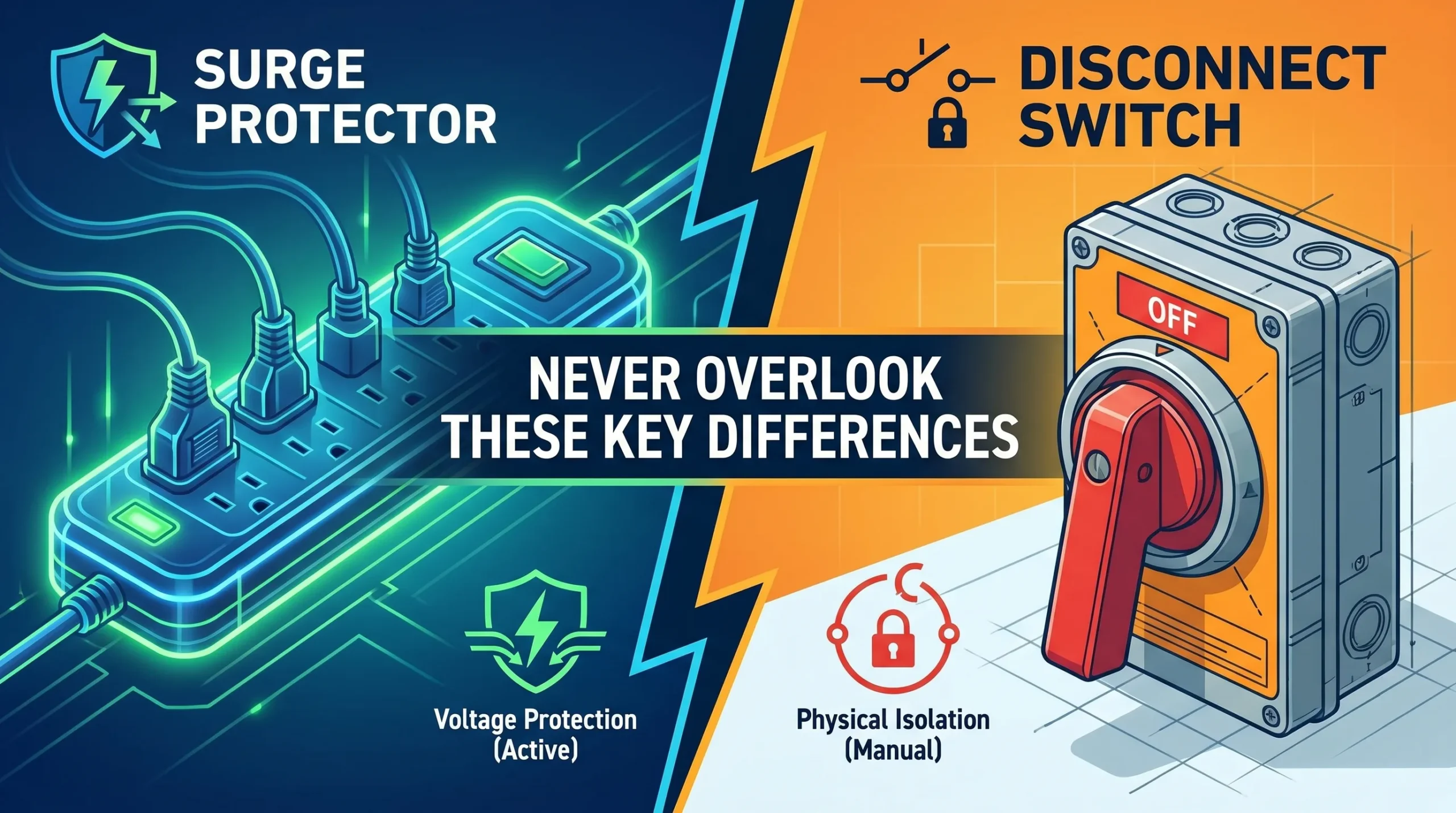
When you choose a surge protector for disconnect, you face a key decision: fused or non-fused safety switch. Fused safety switches cut power instantly during overloads, which protects equipment and keeps people safe in high-voltage settings. Non-fused safety switches work well for smaller jobs, but they may not offer enough protection in demanding environments. Damage from surges can cost facilities thousands and cause frequent downtime. The right safety switch affects your system’s reliability, cost, and compliance with safety rules.
You need to know what a disconnect does before you can make the best choice.
Key Takeaways
-
Understand the difference between fused and non-fused disconnects. Fused disconnects provide built-in overcurrent protection, while non-fused rely on upstream devices.
-
Choose a fused disconnect for high-risk environments. It offers better safety and compliance, especially in industrial settings with high fault currents.
-
Non-fused disconnects are cost-effective and simpler to maintain. They work well when upstream protection is already in place, reducing operational costs.
-
Always check local codes and equipment requirements before selecting a disconnect. This ensures safety and compliance with regulations.
-
Regularly inspect and maintain your disconnects. For fused models, keep spare fuses on hand to avoid downtime and ensure reliable operation.
What Is a Disconnect?
You need to understand what a disconnect does before you can choose the right surge protection for your system. A disconnect switch acts as a gatekeeper for your electrical circuits. It gives you control over when and how power flows to your equipment. This control is essential for both safety and maintenance.
Definition and Function
A disconnect switch serves several important roles in both homes and businesses. You use it to quickly cut off power during emergencies. This action helps prevent accidents and keeps people safe. The switch also protects your equipment from damage caused by overloads or faults. When you need to repair or inspect a system, disconnects let you isolate circuits safely. This feature reduces downtime and makes maintenance easier. In many cases, electrical codes require you to install a disconnect switch to meet safety standards.
Here is a table that summarizes the main functions of a disconnect:
|
Function |
Description |
|---|---|
|
Safety |
Lets you shut off power fast in emergencies, preventing electrocution and accidents. |
|
Equipment Protection |
Shields equipment from overloads or faults, saving money on repairs and replacements. |
|
Maintenance Facilitation |
Allows safe isolation of circuits for repairs, improving efficiency and reducing downtime. |
|
Compliance with Codes |
Meets National Electrical Code (NEC) requirements for certain equipment, ensuring safety and reliability. |
Role in Surge Protection
A disconnect switch plays a key part in surge protection. When you install surge protectors, you often connect them near disconnects. This setup allows you to stop dangerous voltage spikes before they reach sensitive equipment. The disconnect switch lets you safely work on or replace surge protection devices without risk. You also gain peace of mind knowing you can quickly isolate a problem if a surge occurs. By using the right disconnect, you improve both the safety and reliability of your electrical system.
Fused Disconnects
How Fused Disconnects Work
When you use a fused disconnect switch, you get a device that combines a manual power shutoff with built-in protection. The switch uses a mechanical handle that you move to turn power on or off. Inside, a set of blades connects or disconnects the circuit. When you move the handle to the off position, the blades separate from the contacts. This action isolates the fuse from both the power source and the equipment. You can then replace the fuse safely.
The quick-break and quick-make design reduces the time the contacts are close together, which limits electrical arcing and protects the switch. Fusible disconnects give you a reliable way to de-energize circuits for maintenance or emergencies, especially in places with high fault currents.
Overcurrent and Surge Protection
Fusible disconnects stand out because they offer both manual disconnection and over-current protection. Each fused disconnect switch contains fuses that blow if the current gets too high. This feature stops the flow of electricity during overloads or short circuits. You do not have to rely on upstream devices for fault protection. The built-in protection responds instantly to electrical faults, which helps prevent equipment damage and reduces fire risk.
Fusible disconnects also help protect against surges, including those caused by lightning. You get both over-current protection and short circuit protection in one device, making your system safer and more reliable.
|
Feature |
Fused Disconnect Switch |
Non-Fused Disconnect |
|---|---|---|
|
Yes |
No |
|
|
Short Circuit Protection |
Yes |
Depends on upstream |
Pros and Cons
Fusible disconnects offer several advantages and a few drawbacks. You gain over-current protection, dual function for isolation and protection, and better safety compliance. These switches help prevent fires and protect against lightning surges. However, you may face higher costs and need to check or replace fuses regularly.
Fusible disconnects also take up more space and add some complexity to your setup.
|
Advantages |
Disadvantages |
|---|---|
|
Overcurrent Protection |
Higher Cost |
|
Dual Function (isolation and protection) |
Maintenance Needs (checking fuses) |
|
Safety Compliance |
Complexity |
|
Fire Prevention |
Space Requirement |
|
Protection from Induced Lightning Surges |
|
Non-Fused Disconnects
You have seen how fused disconnects combine isolation and protection. Now, let’s look at non-fusible disconnects and how they fit into modern electrical systems.
How Non-Fused Disconnects Work
Non-fusible disconnects give you a simple way to isolate electrical circuits. When you operate the switch, you create a clear break in the circuit. This action stops the flow of electricity to your equipment. Unlike fused options, a non-fusible disconnect does not provide overcurrent protection. Instead, you rely on upstream devices, such as circuit breakers, to handle faults or overloads.
This approach matches the design of many modern systems, where protection happens at the distribution level. You use non-fusible disconnects when you want safe isolation without adding extra components.
Isolation and Convenience
Non-fusible disconnects offer several practical benefits for maintenance and installation. You can see these advantages in the table below:
|
Benefit |
Explanation |
|---|---|
|
Ease of Maintenance |
Non-fusible disconnects have fewer moving parts and no additional components, leading to lower long-term operational costs. |
|
Smaller Enclosure Size |
They only contain a switching mechanism, making them more compact and suitable for efficient panel design. |
|
Simpler Installation Process |
Installation is straightforward as it requires only connecting line and load conductors, reducing space adjustments. |
|
Lower Operational Costs |
With no fuses to replace, maintenance costs are minimal, resulting in lower overall operational expenses over time. |
You will find that non-fusible disconnects make routine tasks easier. You spend less time on maintenance and save space in your electrical panels. These features help you keep your system efficient and cost-effective.
Pros and Cons
Non-fusible disconnects bring both strengths and weaknesses to your setup. Here are some key points to consider:
-
You get reliable isolation for safety and maintenance.
-
You avoid the hassle of checking or replacing fuses.
-
You benefit from a smaller, simpler device that fits tight spaces.
-
You must depend on upstream protection for overcurrent events.
-
You may not meet code requirements in every situation, especially where local rules demand built-in protection.
Fused vs Non-Fused: Key Differences
You have learned how each disconnect switch works and what makes them unique. Now, let’s compare them side by side. This section will help you see the most important differences in protection, safety, maintenance, cost, and code compliance. Understanding these differences will guide you to the best choice for your surge protection system.
Protection and Safety
When you look at protection and safety, the type of disconnect switch you choose makes a big difference. Fused disconnects give you built-in overcurrent protection. The fuse reacts quickly, often in milliseconds, to stop dangerous currents. This fast action helps prevent equipment damage and reduces the risk of fire or arc flash. You get an extra layer of safety, especially in high-voltage or hazardous locations.
Non-fused disconnects focus on isolating the circuit. They do not provide overcurrent protection themselves.
Instead, you must rely on upstream breakers or fuses for this job. This setup works well in less demanding environments, but it may not offer enough safety where fault currents are high.
Here is a table that highlights the main differences in protection and safety:
|
Feature/Benefit |
Fused Disconnects |
Non-Fused Disconnects |
|---|---|---|
|
Overcurrent Protection |
Yes, provides valuable overcurrent protection |
No, relies on upstream breakers or fuses |
|
Reaction Time |
Quick, fuses blow in milliseconds |
Slower, relies on upstream devices |
|
Safety |
Added safety, reduces arc flash risks |
Less built-in safety, relies on external protection |
|
Applications |
High voltage, hazardous locations |
Lower voltage, less critical applications |
Maintenance and Cost
Maintenance and cost play a big role in your decision. Fused disconnects require you to check and replace fuses after they blow. This task can add up in both time and money. For example, some users have reported spending $150 in a single month just on blown fuses for a fused disconnect switch. You also need to keep spare fuses on hand, which increases your ongoing costs.
Non-fused disconnects have a simpler design. You do not need to replace fuses, so your maintenance tasks are easier. Most of your work involves cleaning and checking connections. This simplicity leads to lower long-term costs and less downtime.
When you look at installation costs, fused disconnects usually cost more at the start. The extra parts and more complex wiring increase both material and labor costs. Non-fused disconnects are less expensive to buy and install. They typically cost 20-40% less than fused models, and the price gap grows with higher amperage ratings.
-
Fused disconnect switches may need frequent fuse replacements, which can interrupt your operations.
-
Non-fused disconnect switches have minimal maintenance needs and no consumable parts.
-
Over time, non-fused disconnects save you money because you avoid ongoing fuse costs.
-
Fused disconnects have higher long-term costs due to regular fuse replacements.
-
Fused disconnects may also require larger enclosures, which can increase installation labor by 15-25%.
Code Compliance
Electrical codes and standards help you decide which disconnect switch to use. Fused disconnects can handle much higher fault currents. Some models are rated for up to 200,000 amps. This high rating can help you increase the Short-Circuit Current Rating (SCCR) of your panel. You often need this level of protection in industrial settings or where local codes demand it.
Non-fused disconnects have a lower fault current rating. Most are limited to 10,000 amps. You should only use them in environments where fault currents stay below this level. If you install a non-fused disconnect switch in the wrong setting, you may not meet code requirements.
-
Fused disconnects help reduce fault current and boost the SCCR of downstream panels.
-
Non-fused disconnects must be used where fault currents are under 10,000 amps.
-
Some codes, like NEC Article 430, require fused disconnects for motor protection.
-
UL-listed equipment may specify fused disconnects for proper protection coordination.
-
Insurance providers sometimes prefer fused disconnects for high-value equipment.
Choosing a Surge Protector for Disconnect
You have seen how fused and non-fused disconnects differ in protection, safety, and cost. Now, you need to decide which surge protector for disconnect fits your system best. This choice depends on your equipment, the environment, and the level of risk you face.
You also need to think about code requirements and future needs. Let’s break down the main points to help you make a smart decision.
Application Recommendations
When you select a surge protector for disconnect, you must match the disconnect type to your application. Each type works best in certain situations. Here is a table to help you compare:
|
Disconnect Type |
Recommended Applications |
|---|---|
|
Fused Disconnect |
– Isolation and built-in protection for critical safety and fault control. |
|
|
– Overcurrent and short-circuit protection when no upstream protection exists. |
|
|
– Individual branch protection for equipment, so only affected devices shut down during faults. |
|
|
– Motor circuits and HVAC units needing reliable short-circuit protection. |
|
|
– High fault current environments for quick fault interruption. |
|
|
– Compliance with manufacturer-specified fuse protection for warranty and safety. |
|
Non-Fused Disconnect |
– When upstream protection is already in place. |
|
|
– Control panels with coordinated protection where fuses are unnecessary. |
|
|
– Cost-effective projects with tight budgets and low-risk loads. |
|
|
– Reliable isolation without the added expense of fuse protection. |
You should choose a fused disconnect when you work with high-risk loads, such as large commercial equipment, pumps, or compressors. These systems often need fast-acting protection and extra safety. Fused disconnects also help when equipment manufacturers require fuses for warranty or when you have no upstream protection.
Non-fused disconnects work well for lower power circuits or when you already have strong upstream protection.
You might use them in control panels or for lighting circuits in guest rooms. They save space and money, making them a good fit for simple systems with low risk.
Risk and Compliance
You must also consider risk and compliance when choosing a surge protector for disconnect. High-risk loads, such as those in industrial or hazardous locations, need extra care. Fused disconnects provide built-in overcurrent protection, which is often required by the National Electrical Code (NEC) for these environments.
They also help you meet insurance and warranty requirements.
Here are the main factors you should review:
|
Factor |
Description |
|---|---|
|
Voltage Rating |
The disconnect must match or exceed the system voltage to avoid safety issues. |
|
Current Rating |
Ensure the current rating is appropriate for the load to prevent overheating or unnecessary costs. |
|
SCCR |
The short-circuit current rating must align with the available fault current for safety. |
|
Coordination with OCPD |
The disconnect should work effectively with upstream breakers or fuses to limit circuit shutdown. |
|
Maintenance Strategy |
Fused disconnects need fuse replacements, while non-fused models require less maintenance. |
|
Installation Space |
Consider the available space; fused disconnects are typically larger than non-fused ones. |
|
Environmental Rating (NEMA/IP) |
Select a disconnect with the right NEMA or IP rating for the environment. |
|
Future Expansion Capacity |
Choose a disconnect with extra capacity for potential system growth to avoid future upgrades. |
You must also follow these compliance points:
-
The disconnect must meet NEC and local code requirements.
-
Fused disconnects offer built-in overcurrent protection, which may be required for some applications.
-
The disconnect must match your system’s voltage, current, and short-circuit current rating.
-
Many codes require a visible break and lockout/tagout features for safety during maintenance.
-
Always check for the correct UL listing to pass inspections.
Choosing the right surge protector for disconnect protects your equipment, keeps people safe, and helps you avoid costly downtime. Take time to review your system’s needs, the type of loads you have, and all code requirements before making your final choice.
You have seen that fused disconnects offer built-in overcurrent and short-circuit protection, while non-fused disconnects rely on upstream devices. This table highlights the main differences:
|
Feature |
Fused |
Non-Fused |
|---|---|---|
|
Overcurrent Protection |
Yes |
No |
|
Isolation Function |
Yes |
Yes |
|
Cost |
Higher |
Lower |
|
Maintenance |
Fuse replacement |
Minimal |
Choosing the right disconnect ensures your system meets safety codes and operates efficiently. For long-term protection, schedule regular inspections, follow safe maintenance practices, and consult a licensed electrician when in doubt.
Prioritize safety and compliance to protect your equipment and everyone on site.
FAQ
You may still have questions about surge protectors and disconnects. Here are answers to some of the most common ones:
What is the main reason to choose a fused disconnect?
You choose a fused disconnect for built-in overcurrent protection. This protects your equipment from damage and helps you meet safety codes in high-risk environments.
Can I use a non-fused disconnect if I already have circuit breakers?
Yes, you can use a non-fused disconnect when upstream circuit breakers provide overcurrent protection. This setup works well for simple systems and helps reduce costs.
How often should I check or replace fuses in a fused disconnect?
You should inspect fuses during regular maintenance or after a fault. Replace any blown fuses immediately. Always keep spare fuses on hand for quick replacement.
Do local codes always require fused disconnects?
No, local codes do not always require fused disconnects. Some applications allow non-fused disconnects if upstream protection exists. Always check your local code before making a decision.