Quick Summary: Power surges quietly damage circuit boards in modern appliances, with HVAC systems and heat pumps the top priority because they are hardwired and expensive, followed by smart refrigerators, computers, TVs, and laundry gear. A single power strip is rarely enough; the article recommends layering a whole-home Type 1 or Type 2 panel SPD with point-of-use protectors for sensitive electronics, plus protecting data lines like cable and Ethernet. It ranks the six most vulnerable appliances and lists four more groups, then advises matching protection to each load and checking grounding, since damage often shows up weeks later as early part failure.
Your refrigerator hums along. The thermostat still shows a number. The TV turns on when you press the button. So everything looks fine after a surge, right? Not always. One spike can quietly fry the circuit boards inside these machines. The damage shows up weeks or months later as a part that fails early. Modern homes are full of hidden electronics. Compressors, motors, sensors, displays, and network chips now live inside appliances most people still think of as simple. A flash of lightning, a utility switch, power coming back after an outage, or a big motor kicking on can hurt them fast or wear them down over time.
This guide ranks the most vulnerable appliances and shows what protection each one needs, from a grounded whole-home surge protective device to a listed point-of-use protector. The ranking weighs electronic complexity, motor activity, hardwired exposure, connection paths, cost of failure, and whether a plug-in protector is even enough for the appliances most at risk from power surges.
Quick Comparison of Vulnerable Appliances
| Appliance | Best for | Primary risk | Recommended protection | Common warning sign |
|---|---|---|---|---|
| HVAC systems and heat pumps | Whole-home and dedicated equipment protection | Compressor, motor, and control-board damage | Grounded Type 1 or Type 2 panel SPD, plus dedicated protection if specified | System will not start, short-cycles, or shows thermostat and control errors |
| Smart refrigerators and freezers | Essential kitchen equipment and food storage | Compressor electronics, sensors, displays, and control boards | Whole-home SPD, with appliance-specific protection only if approved for the circuit and model | Erratic cooling, incorrect temperature display, dead dispenser, or random resets |
| Home computers and workstations | Home offices, schoolwork, creative work, and data storage | Power-supply, motherboard, storage, and data-line damage | Listed point-of-use SPD or UPS, coordinated with whole-home protection and data-line protection | Unexpected shutdowns, failed startup, crashes, corrupted files, or network loss |
| Televisions and home theater systems | Living rooms, media rooms, and connected entertainment centers | Display boards, power supplies, HDMI equipment, and communication ports | Listed point-of-use SPD with appropriate coaxial or data-line protection, backed by whole-home protection | No picture, flickering, failed inputs, random resets, or loss of smart features |
| Washing machines and dryers | Laundry rooms with smart or electronically controlled machines | Control boards, motors, pumps, sensors, and displays | Whole-home SPD or electrician-approved appliance protection | Cycle stops, display errors, failed spin or heat, or unresponsive controls |
| Smart ovens, ranges, dishwashers, and microwaves | Digitally controlled kitchen appliances | Timers, touch panels, relays, sensors, and control boards | Whole-home SPD or correctly rated appliance protection approved for the circuit | Blank display, persistent error code, incomplete cycle, or failed heating control |
What to know about vulnerable appliances
The appliances most at risk from a power surge are not the ones that use the most electricity. Risk comes from what’s inside: control boards, sensors, displays, and compressors that fail the moment voltage spikes.
A surge can come from outside through utility wiring, or start inside your home when a big motor or compressor kicks on. It can also travel through cable, Ethernet, phone, and antenna lines, skipping the outlet entirely.
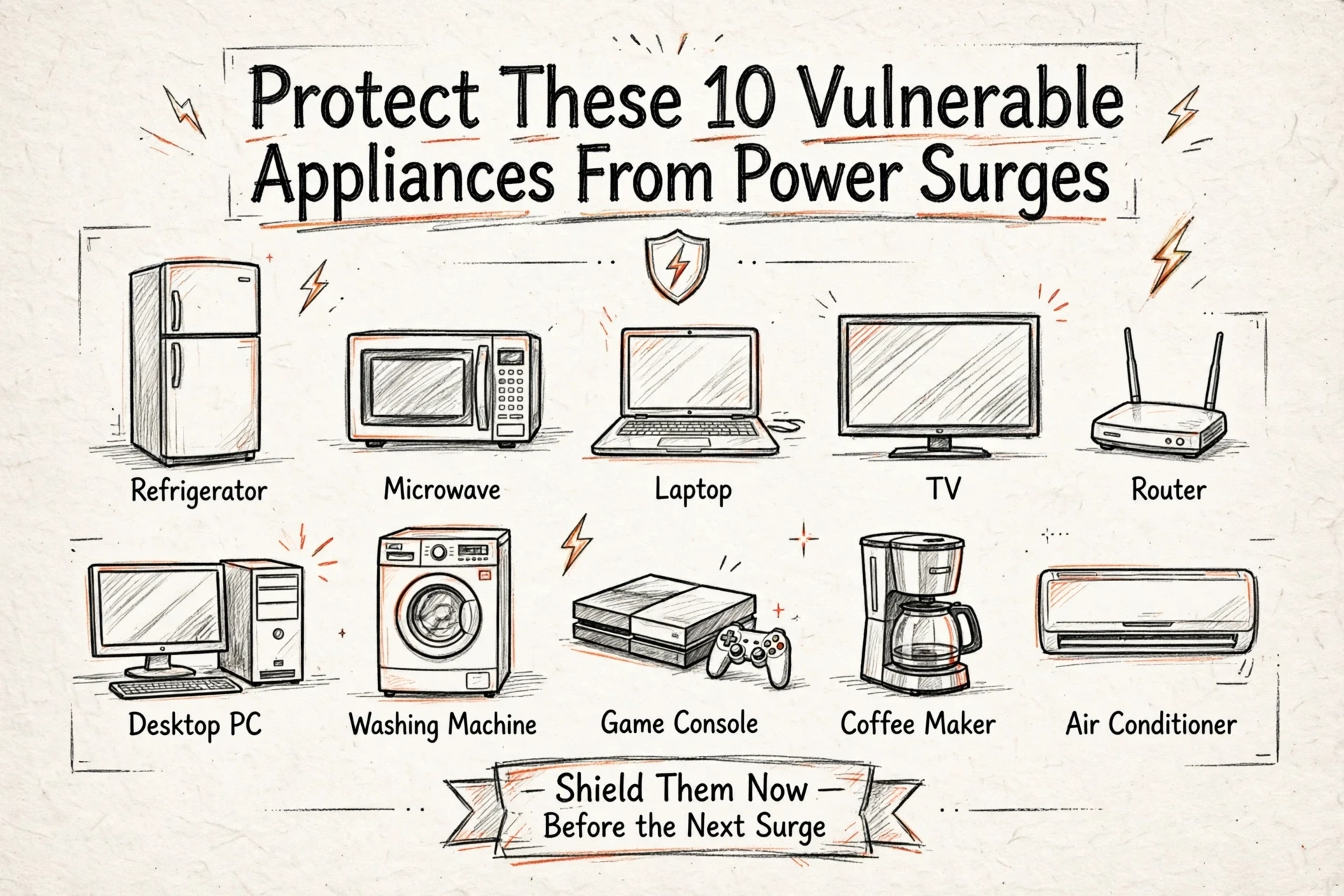
That’s why one power strip is rarely enough. Good protection layers up: solid grounding, panel-level protection, and point-of-use protection where it counts. Here are the ten appliances worth protecting first.
1. HVAC systems and heat pumps
This is the highest-priority protection target in many homes, and for good reason. HVAC systems and heat pumps pair large compressors and motors with delicate control boards, sensors, and communicating thermostats. Since the equipment is hardwired, a regular plug-in surge strip offers no real help.
Highlights
- Large compressors and motors create internal switching transients that slowly wear down electronics
- Outdoor units face lightning and utility-line events head-on
- A surge can leave the system unable to start, short-cycling, or showing thermostat errors
Specs
- Primary risk: Compressor, motor, and control-board damage
- Recommended protection: Grounded Type 1 or Type 2 panel SPD, plus a dedicated device at the outdoor disconnect if specified
- Warning sign: System will not start, or shows control and thermostat faults
Pros
- A whole-home panel SPD covers hardwired HVAC equipment
- Layered protection handles both incoming and internal surges
Cons
- Panel and dedicated protection need professional installation
- No SPD stops every direct lightning strike
HVAC ranks first because it combines high replacement cost, big inductive loads, sensitive electronics, outdoor exposure, and no plug-in protection option.
Also Read: Are Surge Protectors One Time Use
2. Smart refrigerators and freezers
Food storage now depends on delicate electronics. A modern fridge runs on control boards, inverter compressors, sensors, and Wi-Fi modules, and even a basic model without a touchscreen still manages cooling electronically. A surge can hit any of these parts, and it often does so without smoke or noise. Repairs after storms usually trace back to a fried control board, not the compressor itself, according to A Plus Appliance Repair.
Highlights
- Compressors and inverter electronics face stress from switching events.
- Smart displays and Wi-Fi features add more exposed circuitry.
- A failed board can put food at risk even if the cabinet looks fine.
- A whole-home SPD covers the fridge better than a basic power strip.
Pros
- Panel-level protection covers the fridge without loading a strip.
- A layered setup cuts exposure from both outside and inside surges.
Cons
- Built-in protection is no substitute for home-wide coverage.
- The fridge must stay plugged in, so unplugging is rarely practical.
Specs
- Primary risk: Compressor electronics, sensors, displays, and control boards
- Recommended protection: Whole-home SPD; point-of-use only if rated for the circuit and model
- Warning signs: Erratic cooling, wrong temperature display, dead dispenser, random resets
It ranks second because fridges stay powered 24/7 and repeated small spikes wear boards down over time, as Mr. Electric explains. Losing one disrupts the whole kitchen.
3. Home computers and workstations
A desktop PC holds processors, memory, and files in one small box. A single surge can kill it instantly, but smaller repeated hits may cause crashes, corrupted storage, or random restarts. That data loss often costs more than the hardware itself.
Highlights
- Power supplies and motherboards are sensitive to sudden voltage spikes
- A surge can hit hardware and connected storage at the same time
- Ethernet, phone, and cable lines offer extra paths for surges to sneak in
- A UPS helps during outages, but it must also include real surge protection
Specs
- Best for: Home offices, schoolwork, creative work, and data storage
- Primary risk: Power-supply, motherboard, storage, and data-line damage
- Recommended protection: A listed point-of-use SPD or UPS, plus data-line protection
- Warning sign: Shutdowns, failed startups, crashes, or corrupted files
Pros
- A quality point-of-use SPD is easy to add at a desk
- A UPS gives short runtime during an outage while cleaning up power
Cons
- A basic power strip may offer no surge protection at all
- A UPS is no substitute for backups or protection on network lines
Computers rank this high because their electronics are fragile and one workstation often links to several other devices and outside lines.
4. Televisions and home theater systems
A smart TV packs processors, network radios, and a fragile power supply into one screen. Add a receiver, soundbar, console, and cable box, and a surge has many ways in. Cable, satellite, antenna, and Ethernet lines can bypass a power-only strip, so a TV that still turns on after a storm may later show flickering, failed inputs, or random resets.
Highlights
- Smart displays combine power supplies, processors, and radios in one device.
- Signal lines can carry a surge that power-only strips miss, which is why coax and Ethernet protection matters.
- Receivers hold large capacitors and touchy control circuits.
Pros
- One well-rated protector can cover the whole entertainment cluster.
- Data-line ports close paths a basic strip leaves open.
Cons
- Too many high-load devices can overload a single strip.
- Cable and antenna protection must be grounded correctly.
Use a listed point-of-use SPD with coax or data-line ports, backed by whole-home protection. Theaters have used this approach for years, and the Eaton Tripp Lite HT10DBS is a good example.
Televisions rank fourth because they are electronically dense, tied to outside lines, and usually grouped with devices that share a surge path.
Also Read: Appliance Surge Protector
5. Washing machines and dryers
Laundry appliances combine motors, heaters, sensors, and digital controls in one cabinet. A surge can fry a washer’s control board mid-cycle or knock out a dryer’s heat and display.
Highlights
- Motors, pumps, and switching loads can create internal transients.
- Touch controls and smart features add more electronics to fail.
- Dedicated circuits do not eliminate surge exposure.
- Whole-home protection is generally more suitable than a conventional strip.
Specs
- Best for: Laundry rooms with smart or electronically controlled machines
- Primary risk: Control boards, motors, pumps, sensors, and displays
- Recommended protection: Whole-home SPD or electrician-approved appliance protection
- Warning sign: Cycle stops, display errors, failed spin or heat, or unresponsive controls
Pros
- Panel-level protection covers appliances that should not use a standard strip.
- A whole-home SPD also helps protect other laundry-room circuits.
Cons
- A dedicated circuit is not the same as surge protection.
- Installation and compatibility depend on local wiring and appliance requirements.
It ranks fifth because motor-driven loads meet sensitive controls here, and ordinary point-of-use gear can’t protect them easily – just below refrigerators, since a dead washer is less urgent than lost food.
Also Read: Are Surge Protectors Necessary
6. Smart ovens, ranges, dishwashers, and microwaves
Kitchen controls can fail even when the heating elements look fine. Modern ovens, dishwashers, and microwaves lean on timers, touch panels, sensors, relays, and Wi-Fi modules, and a surge can leave a display blank or a dishwasher stuck mid-cycle. Appliance technicians see control boards die first after storms, while motors and elements often survive.
Highlights
- Digital controls and touch interfaces are common failure points
- Built-in units may be hardwired, so a strip is impractical
- Microwaves pair high-power parts with delicate electronics
- Match protection to the circuit and the manufacturer’s instructions
Specs
- Best for: Digitally controlled kitchen appliances
- Primary risk: Timers, touch panels, relays, sensors, and control boards
- Recommended protection: Whole-home SPD or correctly rated appliance protection approved for the circuit
- Warning signs: Blank display, error codes, incomplete cycle, or failed heating control
Pros
- Whole-home protection covers several built-in kitchen appliances at once
- Correctly rated point-of-use protection can suit countertop equipment
Cons
- A standard strip may be unsafe for high-wattage kitchen loads
- A protector should never block ventilation, heat clearance, or installation requirements
Why it ranks sixth: many contain sensitive electronics and some are hardwired, but a single failure is less urgent than HVAC, food storage, or critical computing losses.
Other Appliances Worth Protecting
The six entries above need the closest attention, but four more appliance groups face the same surge pathways.
- Routers, modems, and networking equipment – Protect both the power connection and any incoming data or phone line.
- Gaming consoles and audio equipment – Sensitive processors and power supplies make these easy to overlook but costly to replace.
- Garage door openers and gate controls – Motor controls and outdoor wiring add exposure a plug-in strip may not cover.
- Smart-home, security, and medical-support equipment – Prioritize protection for systems whose failure affects safety or care.
How to choose the right surge protection for your home
Start with what hurts most to lose. HVAC boards, fridge compressors, home-office computers, and medical devices get priority. Then build in layers:
- Add whole-home protection first. A panel-mounted Type 1 or Type 2 SPD cuts incoming surge energy for every circuit.
- Use point-of-use devices behind it. Listed Type 3 protectors add a second layer for computers, TVs, and network gear.
- Match the device to the load. Never plug a range, dryer, or HVAC unit into a power strip. Ask an electrician or follow the appliance maker’s specs.
- Check your wiring. SPDs need solid grounding, bonding, and a compatible panel. Have an old or modified setup inspected first.
- Protect every path. Cable, Ethernet, phone, and antenna lines can carry surges too.
- Buy certified and replaceable. Look for recognized safety marks, a status indicator, and clear replacement rules.
For plain-English picks and setup guides, our buying guides at Gag the Surge walk through rated, certified options for each layer.
One surge can wreck any of the ten appliances on this list. Don’t wait for the next storm. Visit Gag the Surge for honest reviews, buying guides, and simple steps to protect your home today.
Frequently Asked Questions
Q1: Which home appliances need surge protection the most?
Anything with a circuit board: refrigerators, washing machines, HVAC systems, and microwaves. Repairs often cost more than a surge protector, so shield the expensive items first.
Q2: What are the 10 most vulnerable appliances to power surges?
Refrigerators, washers, dryers, dishwashers, ovens, microwaves, HVAC units, smart TVs, gaming consoles, and garage door openers. Each relies on delicate electronics that fail quietly after repeated small surges.
Q3: How do power surges damage appliances?
Extra voltage overheats circuit boards and fries capacitors instantly. Smaller surges wear parts down over months, so an appliance dies long before you suspect a surge was the cause.
Q4: What is the best surge protector for appliances?
Use a whole-home surge protector from Eaton or CyberPower for broad coverage, plus point-of-use protectors for big appliances. Check the joule rating; higher is better.
Q5: How to protect appliances from power surges at home?
Install a whole-home unit at the panel, plug valuables into quality protectors, and unplug during major storms. Replace protectors every few years since they wear out silently.
Q6: Do surge protectors expire?
Yes. They absorb surges until their capacity runs out, then stop protecting. Many models, like some Belkin units, have an indicator light – replace the unit when it warns you.