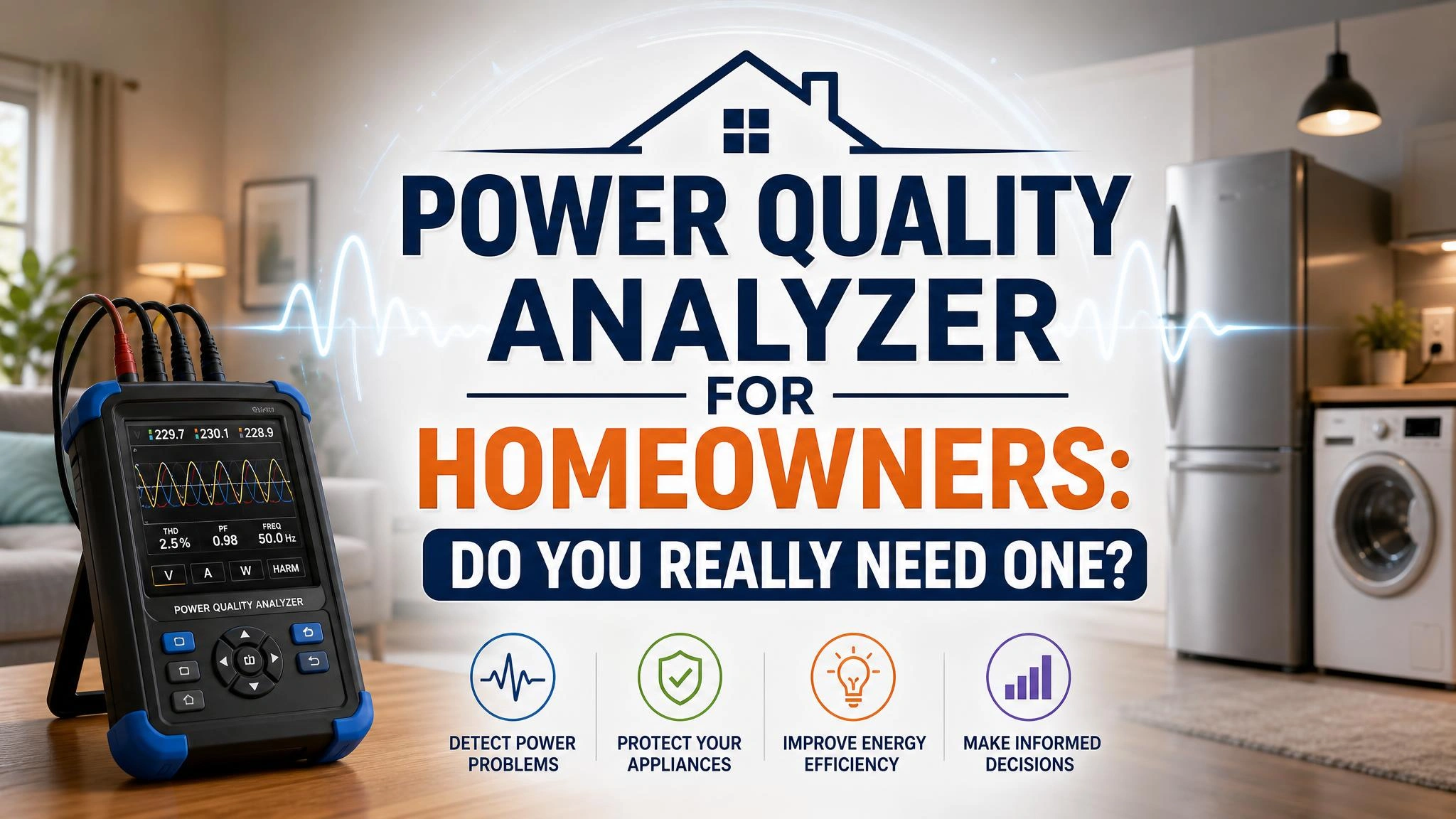
A power quality analyzer for homeowners can help explain electrical problems that a standard multimeter cannot catch: lights that flicker only at certain times, computers that restart without warning, appliances that behave erratically, or breakers that trip when a large load starts.
The key difference is time. A multimeter gives you a reading at one moment. A power quality analyzer records voltage, current, frequency, waveform behavior, and electrical events over hours or days. That makes it useful when the problem appears for a fraction of a second and then disappears before anyone reaches the panel.
For most homes, a full professional analyzer is not the first tool to buy. It can be expensive, complicated, and unnecessary if the issue is limited to one plug connected device. But it becomes much more useful when symptoms affect multiple rooms, recur unpredictably, or appear connected to HVAC equipment, an EV charger, a well pump, or utility outages.
Table of Contents
TL;DR
A power quality analyzer is most valuable when you need evidence of intermittent voltage problems, not simply an estimate of energy use. Start with long duration voltage logging for unexplained resets or flicker. Add current measurement when you need to connect the event to a specific household load. Do not install panel connected equipment yourself unless you are qualified to work safely around energized electrical equipment.
Key Takeaways
- A basic energy monitor shows consumption patterns, while a power quality analyzer is designed to capture disturbances such as voltage sags, interruptions, waveform distortion, and flicker.
- Most US homes have 120/240 V split phase service. A single phase device that can monitor both legs may be sufficient; three phase capability is usually unnecessary for a typical residence.
- Logging for several days is often more useful than watching live readings for ten minutes, especially when a problem occurs during storms, overnight HVAC cycles, or utility switching.
- A report can help narrow down whether a problem follows a specific circuit, a major appliance, or the incoming utility supply. It rarely proves responsibility by itself.
- An analyzer does not replace surge protection. It helps identify the electrical conditions that may justify layered protection, wiring repairs, or utility follow up.
Choosing the Right Level of Home Power Monitoring
What a power quality analyzer actually does
A power quality analyzer is a recording instrument built to find changes in electrical supply that can affect equipment. Depending on the model, it may measure RMS voltage, current, frequency, power, power factor, energy use, harmonics, flicker, inrush current, interruptions, and waveform events.
Fluke describes power quality analyzers and measurement loggers as tools for finding intermittent power quality and energy efficiency issues that can appear only over time. That time based evidence is the main reason homeowners consider one.
Imagine a home office computer restarts twice a week, often when the air conditioner starts. A plug in watt meter may show the computer’s normal electricity use, but it may miss a brief voltage sag occurring elsewhere on the circuit. A logger that timestamps voltage events can show whether the reset aligns with the HVAC startup or occurs independently.
A true analyzer is not necessarily the best answer for every complaint. If one lamp flickers because of a loose bulb or failing dimmer, the solution may be simple maintenance. If lights dim throughout the home when a heat pump, oven, or well pump starts, recording supply behavior becomes more useful.
Monitor, clamp meter, logger, or analyzer?
The practical buying decision is less about having the largest list of specifications and more about answering one question: What evidence do you need to collect?
| Tool type | Best for | What it can miss | When it is enough |
|---|---|---|---|
| Plug in voltage monitor | A single outlet, basic voltage trends, simple outages | Panel level events, current draw, detailed waveform data | One sensitive device has a repeatable problem |
| Whole home energy monitor | Energy use, load patterns, large appliance consumption | Brief sags, transients, harmonic detail, event waveforms | The main goal is reducing energy use or identifying high loads |
| Clamp meter | Spot checking current and voltage | Events that happen when you are not measuring | A circuit appears overloaded or a motor has unusual running current |
| Power quality logger | Long duration voltage and event tracking | Some models lack current channels or waveform detail | You need to document intermittent sags, swells, or interruptions |
| Full power quality analyzer | Multi channel analysis, current and voltage correlation, waveform capture | It can be costly and requires careful setup | Multiple circuits or whole home symptoms need professional grade evidence |
I recommend starting with the least complex tool that can capture the suspected event. For unexplained resets across several devices, a voltage logger with event capture may be a sensible first step. For a suspected overloaded feeder, HVAC startup issue, or interaction between circuits, current channels become more important.
A whole home energy monitor is helpful, but it is not automatically a substitute for an analyzer. It may tell you that an EV charger began drawing power at 11:00 p.m. It may not show whether the voltage dipped at exactly that moment, how long the dip lasted, or whether waveform distortion increased.
Residential service changes what you need
Most US houses use 120/240 V split phase service, not three phase service. Two hot conductors each provide roughly 120 V to neutral, while 240 V loads use both hot conductors together. Large loads may include an electric range, dryer, central HVAC equipment, water heater, well pump, workshop equipment, or EV charger.
That matters because many high end analyzers are designed for commercial three phase systems. A three phase instrument can still work in a house, but its extra channels and configuration options may offer little value unless the property has unusual service equipment, a large outbuilding, or commercial style electrical loads.
A homeowner focused on ordinary residential service should look for:
- Compatibility with 120 V and 240 V circuits
- Voltage logging on both service legs where possible
- Timestamped sag, swell, interruption, and flicker events
- Data export that an electrician can read without proprietary confusion
- Current clamps only if load correlation is part of the question
- Clear input ratings and instructions appropriate for the intended connection method
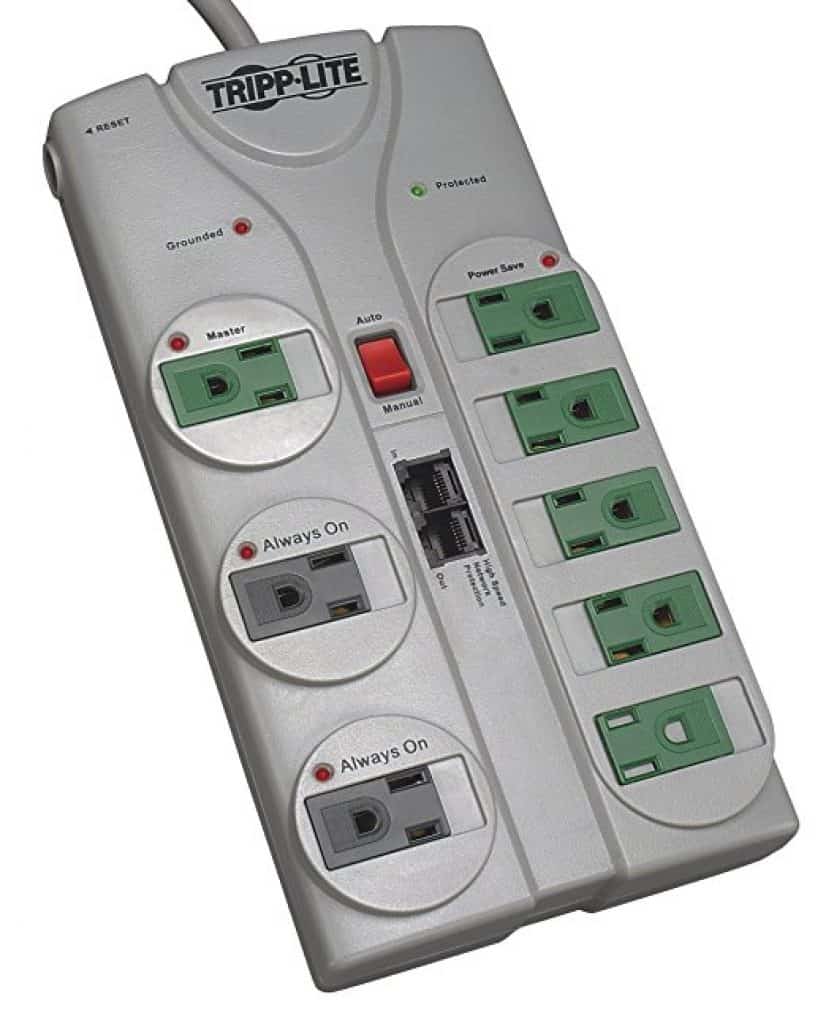
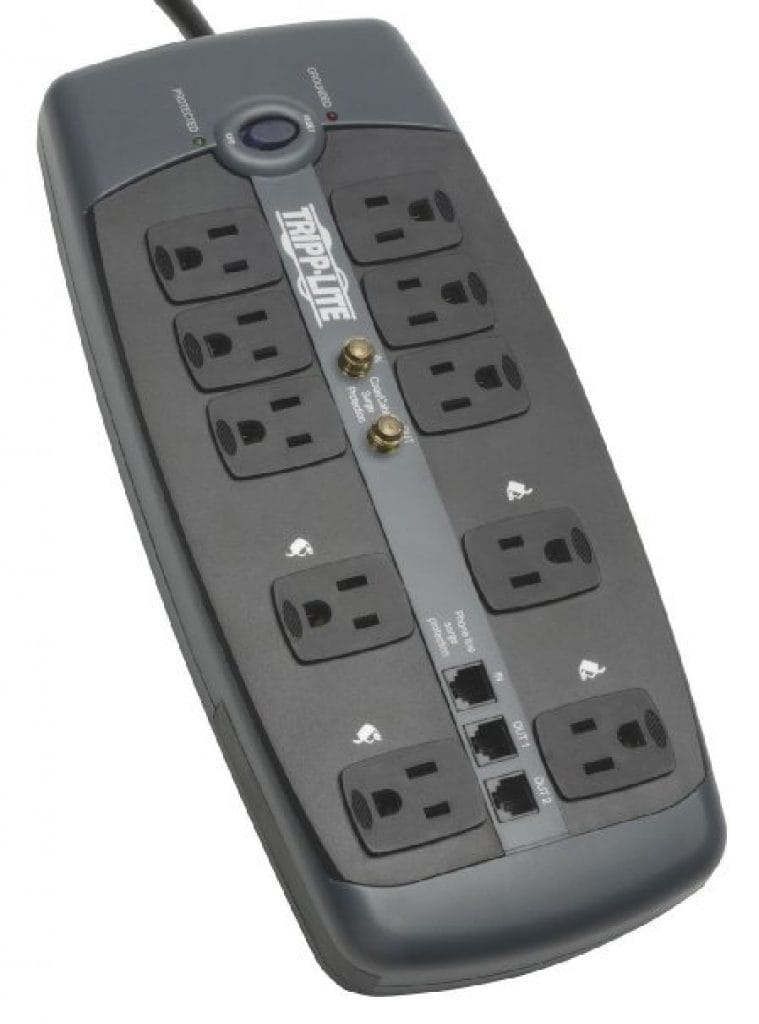
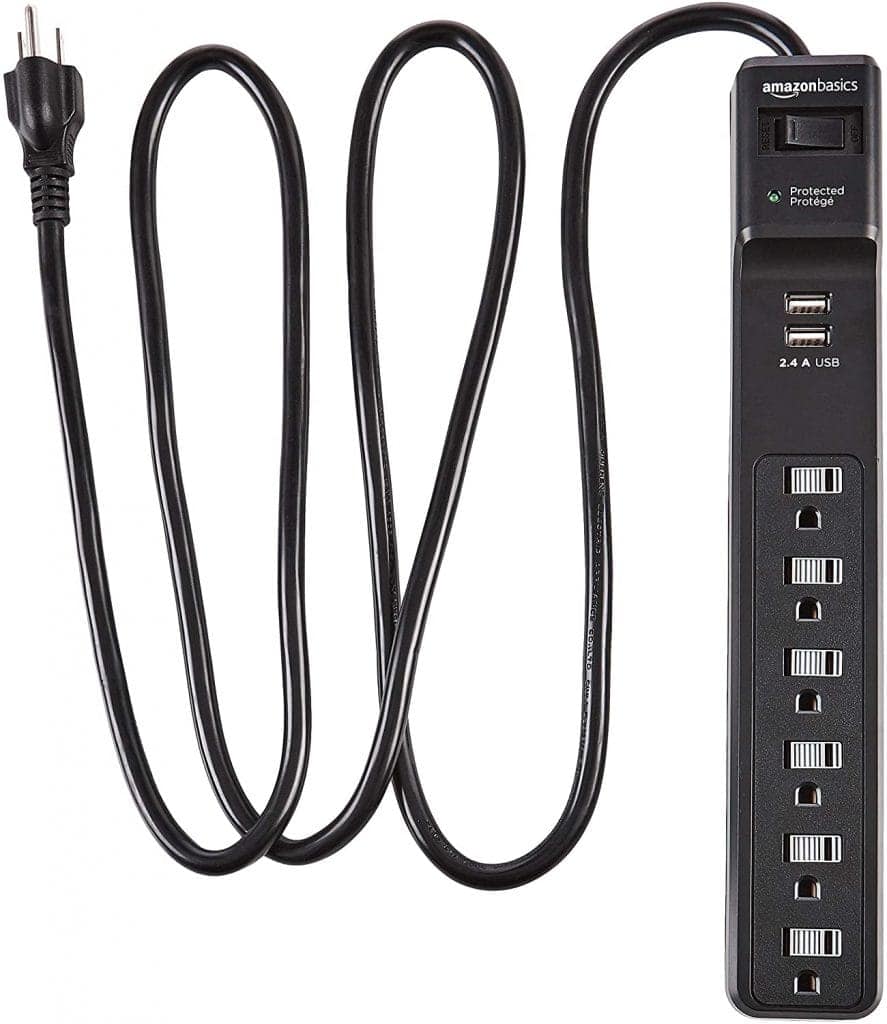
For broader electrical protection planning, a power quality report can also clarify why over voltage protection for home may be worth considering. Monitoring identifies patterns; surge protective devices are intended to reduce exposure to damaging transient overvoltage events.
The Measurements That Matter in a Home
Start with the symptoms, then select the metrics
A professional analyzer may produce dozens of measurements. Homeowners do not need to study every one. Focus first on measurements that connect to the problem you can see or hear.
| Metric | What it indicates | Household symptom it may help investigate |
|---|---|---|
| RMS voltage | Effective supply voltage over time | Lights dimming, electronics restarting, motors struggling to start |
| Frequency | Stability of the AC supply frequency | Unusual timing or equipment behavior, though frequency issues are less commonly the first home diagnosis |
| Voltage sag | Brief drop in voltage | Router resets, garage door hesitation, HVAC controls restarting |
| Voltage swell | Temporary voltage increase | Repeated lamp failures, electronics stress, unusual equipment behavior |
| Momentary interruption | Brief loss of power | Clocks resetting, smart devices reconnecting, computer data loss |
| Flicker | Rapid voltage variation | Visible light fluctuation, especially when motors or chargers cycle |
| THD | Total harmonic distortion, or waveform distortion | Sensitive equipment concerns, heating in some equipment, complex load interactions |
| Inrush current | Startup current spike | Dimming when motors, compressors, or transformers start |
Hioki notes that power quality analyzers can record voltage drops, flicker, harmonics, and interruptions, with waveform events available for later investigation. This is why event recording matters more than a single normal voltage reading.
Why RMS voltage and interruptions come first
For many residential complaints, RMS voltage is the most useful starting point. It represents the effective voltage supplied over a measurement window. When it drops briefly, some electronics can reset even though a basic meter looks normal afterward.
Consider a router that reboots only when the refrigerator compressor starts. If an analyzer shows a voltage sag at the same timestamp, the event is worth investigating. If the router reboots but the recorded service voltage remains stable, the problem may instead involve the router’s power supply, its outlet connection, a local branch circuit, or a failing UPS.
A brief interruption is different from a sag. During an interruption, the supply drops out entirely or nearly entirely for a short period. That can explain why clocks flash, smart lights reconnect, or a cable modem restarts while the rest of the home seems normal.
Harmonics, THD, and waveform distortion
THD, or total harmonic distortion, describes how much an electrical waveform differs from an ideal sine wave. Modern homes contain many electronic loads: LED drivers, laptop chargers, televisions, induction cooking equipment, variable speed HVAC drives, solar inverters, and EV chargers. These loads can change waveform shape.
High THD is not automatically proof that something is unsafe or defective. A reading becomes meaningful when it accompanies a symptom, such as overheating, repeated equipment errors, unusual audible noise, or a pattern that changes when a certain load runs.
MicroDAQ notes that some power quality analyzers measure a wide range of values, including volts, amps, watts, VAR, kWh, power factor, and harmonics through the 63rd harmonic. That depth is useful for an electrician or advanced user, but it can also create false certainty. A complex chart is not a diagnosis unless it is tied to a circuit, an event, and a known operating condition.
If waveform distortion is the concern, do not assume that a conditioner will fix every issue. Learn what does a power conditioner do before treating it as a cure for poor wiring, inadequate service capacity, or an appliance fault.
How to Log and Interpret Electrical Problems Safely
Use a recording plan, not just a device
A useful investigation starts with a written symptom record. Note the time, affected equipment, weather conditions, and which large loads were active. Without that context, a logger can produce pages of data with no obvious meaning.
A practical residential workflow looks like this:
- Define the symptom precisely. “Lights flicker” is broad; “kitchen LEDs dim when the well pump starts” is actionable.
- Start with the least invasive measurement point. A plug in logger near the affected equipment can be safer and may answer the question without panel access.
- Record long enough to cover normal routines. A few hours may be enough for a predictable motor start, but intermittent faults often require several days or longer.
- Enable event capture for sags, swells, and interruptions if the instrument supports it. Trend data alone can smooth out short events.
- Compare timestamps with appliance use, breaker trips, weather events, EV charging sessions, and utility outages.
- Export the report with configuration details: measurement point, date range, recording interval, trigger settings, and the circuit or service leg monitored.
There is no universal recording interval that guarantees success. A one minute average can reveal long undervoltage trends but may completely hide a split second interruption. For nuisance resets, select the fastest practical logging interval and use event triggered capture where available. For energy patterns, longer intervals can be useful because they reduce data volume and show daily load shape more clearly.
Hioki describes its PQ3100 as measuring voltage, current, power, harmonics, and flicker on the same time axis. The value of synchronized channels is straightforward: if voltage changes at exactly the moment a compressor’s current jumps, there is a stronger reason to investigate that relationship.
Separating utility side clues from home side clues
A logger cannot always assign blame, but its location and timing can narrow the possibilities.
| Pattern in the log | What it may suggest | Sensible next step |
|---|---|---|
| Disturbance appears on multiple circuits at the same time | Service level, utility supply, main connection, or large whole home load | Ask a licensed electrician to inspect service equipment; retain records for a utility discussion if appropriate |
| Only one branch circuit shows symptoms | Circuit wiring, receptacle, breaker, local load, or shared neutral issue | Have the circuit evaluated by an electrician |
| Events coincide with one appliance starting | Inrush, appliance fault, undersized circuit, voltage drop, or normal startup behavior | Compare current and voltage data; inspect the appliance and circuit capacity |
| Events align with storms or neighborhood outages | External supply events may be involved | Save timestamps and contact the utility with factual documentation |
| No voltage event appears during the symptom | Device power supply, data connection, software, or local connection may be the cause | Test the affected device separately before escalating electrical work |
Fair warning: normal motor startup can look alarming in a chart. A refrigerator, heat pump, garage door opener, or well pump may create an inrush event without causing a dangerous supply problem. The important question is whether the event is proportionate, repeatable, and linked to symptoms elsewhere.
Panel safety and professional boundaries
Clamp on current measurement sounds noninvasive, but panel work is not risk free. Opening an energized electrical panel exposes conductors and terminals that can remain live even when individual breakers are off. Improper placement can damage equipment, create inaccurate readings, or expose the installer to shock and arc hazards.
For that reason, I would treat plug in monitoring as the homeowner friendly option and panel connected monitoring as electrician work unless you are appropriately trained and authorized to perform it. This is especially true when voltage leads must be connected near service conductors or when the panel has limited space, damaged components, moisture, corrosion, or unclear labeling.
An electrician can also distinguish between a load related voltage drop and a wiring defect. For example, a loose neutral can create unpredictable voltage behavior across 120 V circuits and deserves prompt professional attention. Do not try to diagnose or tighten service connections yourself.
If the issue turns out to be electrical noise affecting sensitive audio, networking, or entertainment equipment, power line conditioners may be part of a broader equipment protection strategy. They should not be used as a substitute for correcting unsafe wiring or service defects.
Frequently Asked Questions
Do I need a power quality analyzer or just a power monitor?
Choose a power monitor when your goal is energy use: identifying expensive appliances, tracking consumption, or comparing operating costs. Choose a power quality analyzer or logger when you need to capture why devices reset, lights flicker, or equipment fails at unpredictable times. A monitor may show when a load starts; an analyzer is better suited to recording the electrical disturbance associated with that start.
Can a power quality analyzer find voltage sags and surges in a house?
It can detect and record voltage sags, swells, interruptions, and, depending on the model, transient events. Its usefulness depends on correct setup, sufficient recording duration, and trigger settings. Very fast transients can require more capable equipment than an entry level logger provides.
Will it help diagnose flickering lights?
Often, yes. It can show whether flicker coincides with voltage variation, a large motor starting, or an event on the service. It cannot by itself rule out a failing LED bulb, incompatible dimmer, loose lamp connection, or defective fixture. Start with the simple fixture checks before investing in extensive monitoring.
What does THD mean, and does it matter at home?
THD means total harmonic distortion. It indicates waveform distortion caused by non linear electrical loads. It matters most when distortion is paired with a specific symptom or when an electrician is evaluating sensitive equipment, heating, or load interactions. A THD number alone does not establish that your home has a dangerous electrical problem.
Can a clamp meter replace a power quality analyzer?
A clamp meter is excellent for checking current at a particular moment. It usually cannot replace an analyzer for intermittent problems because it does not continuously log disturbances, synchronize multiple channels, or capture voltage events over days. Use a clamp meter for spot checks and an analyzer for evidence over time.
How long should I log before I can spot a problem?
Log long enough to include the conditions when the symptom normally occurs. For a predictable issue, such as dimming every time an HVAC system starts, one day may be enough. For random resets, weekend outages, or weather related events, several days or longer may be necessary. Keep a timestamped symptom diary alongside the recording.
Can an analyzer prove that the utility is responsible?
Usually not on its own. It can provide useful evidence that events occurred at a particular time and measurement point. If similar disturbances affect multiple circuits or coincide with neighborhood issues, the report may support a utility conversation. An electrician may still need to rule out service equipment, panel, grounding, or wiring issues inside the home.
Is it safe to install a power quality analyzer in my electrical panel?
It may be safe when installed by a qualified person using equipment rated for the system and installed according to its instructions. It is not a casual DIY task merely because current clamps do not pierce a conductor. Live voltage connections and exposed panel components create meaningful hazards.
Conclusion
A power quality analyzer for homeowners is best viewed as a diagnostic recorder, not a universal fix. It earns its cost when electrical symptoms are intermittent, affect more than one device, or need documented evidence before you call an electrician or utility.
Start with the simplest safe measurement method, log long enough to catch real conditions, and compare the results with actual appliance activity. If the data points to service equipment, wiring, or repeated voltage events, bring a clear report to a licensed electrician rather than trying to solve a panel level problem alone.
Sources/References
- fluke.com: https://www.fluke.com/en-us/products/electrical-testing/power-quality
- hioki.com: https://www.hioki.com/us-en/products/pqa/power-quality/id_6735
- hioki.com: https://www.hioki.com/global/products/pqa/power-quality/id_6619
- hioki.com: https://www.hioki.com/global/products/pqa/power-quality/id_6735
- microdaq.com: https://microdaq.com/data-loggers/power-quality.php